That's right, I said it. Anyone who's been to Egypt knows the ridiculous "convoy system" is more a danger than a help.
This particular rant is coming today because I just saw this story on CNN:
Six Belgians Die in Bus Accident in EgyptA couple of weeks ago, a bus lost control on the road between Abu Simbel and Aswan. Surprise surprise, the accident was caused by "speeding, careless driving, and poor road conditions." I'll agree those things were all proximate causes - in Egypt, that's just called driving.
But the bigger issue is the government's instistence on the "convoy system," a relic of the security situation in Egypt in the late 1990s. Briefly,
nearly 60 tourists were massacred in Hatshepsut's Temple in Luxor by Islamic militants looking to destabilize Egypt's government and tourist industry. The government attempted to save the tourist industry by reducing the liability of the tour operators - in other words, by jacking the "security" level through the roof. The government also spent several years wiping out the "terrorist" groups throughout Egypt. I'm whitewashing a complex issue here (I'm overlooking the bombings in Sinai, for example), but the core of the argument is valid.
So if the terrorists are gone, why are the movements of foreigners still strictly regulated?
In the major tourist centers such as Luxor, Aswan, and Abu Simbel - in other words, basically anywhere outside Cairo or Alexandria - foreigners can only move between sites in large groups accompanied by a police presence (sometimes, incredibly, a helicopter). A few friends of ours have done the convoy, although I haven't been in one of the big ones. Here's a picture I found on the web:
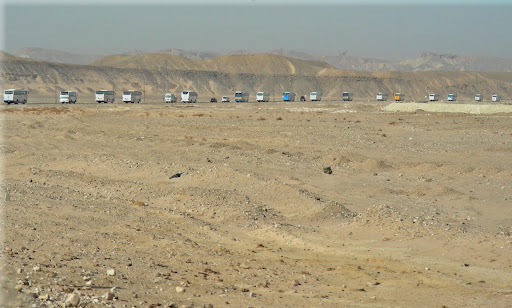
So you've got at least one police truck leading, then a huge group of buses and minibuses, then at least one police truck following. There's frequently security inside some of the buses - which means a guy you don't know brings a gun (possibly even containing bullets) onto your bus without your permission. The police, of course, want to spend the absolute minimum amount of time actually working - and no doubt this job is excrutiatingly boring - so they lead the convoy through the desert at breakneck speed. The roads are terrible, the bus drivers aren't trained for racing, and for that matter, neither are the police. It's a recipe for disaster - and that disaster has struck over and over.
Now let me ask you a hypothetical question. Let's say you're a terrorist. Let's say you're looking to destabilize the political system in Egypt by killing a bunch of tourists and bringing down Egypt's tourist economy. You know that every single day, every tourist for fifty miles gathers in exactly the same place at exactly the same time. Here's the question - where, pray tell, are you going to put your bombs? Where's the most logical place?
I'm completely disgusted by this irrational nonsense. Last weekend I went to
Minya in Middle Egypt with some of my colleagues. We were an official AUC event - we had
two security men from AUC, my boss had arranged all our clearance in advance, and we were running late from the horrendous traffic in Cairo.
We got out to the first checkpoint out on the highway and our bus was stopped.
Are there foreigners on this bus? You're not allowed to drive on this road at night! Turn around!
Granted, I loathe driving in Egypt at night. The drivers have this idiotic idea that driving with headlights off saves them money. Except, of course, just as you're passing another car, when you flip on your brights. I don't see how being dead is a tradeoff, but hey, maybe I'm the irrational one. And this highway is an exceptionally fatal one, due to all the heavy transport trucks speeding without headlights. So while I agreed with the decision on safety grounds, why in the name of God had we not been informed about this a week ago when my boss obtained our clearance for our travel schedule?
We turned around and headed for another highway. It got later and later. Finally we got to the first checkpoint on this second highway. And big surprise - since we were a busload of Americans, we had to have a
police escort to drive on the highway. The cops had to be found, and woken up, and a truck had to be found for them to escort us ... all the way to the next local political boundary. Where the process had to be repeated from scratch (find cops, wake up cops ...) because no one called ahead to say we were coming. On the straight road. We didn't get to Minya until 2 in the morning.
And here's the best part. So we're going down the Corniche next to the Nile in downtown Minya. It's 2 o'clock in the morning and our police escort
turns his lights and sirens on! Just in case there was a single terrorist in the 150 miles between Cairo and Minya who
didn't know there was a busloads of Americans in the vicinity - our escort took care of that.
The next evening, after a long day's touring, a group of us wanted to go out, have a coffee, and smoke a shisha. Our security detail attempted to prevent us from leaving the hotel! So we're a group of AUC professors, who live in Cairo, and (to varying degrees) speak Arabic - and we're not permitted to leave our hotel in the evening! Needless to say, we weren't tolerating that bullshit. I learned how to say, "Am I a prisoner?" in Arabic. See? We're back to the
Reverse Prison!So why does this system exist at all? The government claims it's to protect its visitors - especially those notoriously lawsuit-lovin' Americans. But protect us from what exactly? If the government has wiped out all the terrorists - or had any effect whatsoever in reducing the threat of extremist violence - what do we have to be afraid of?
Along the same lines, if the government has wiped out all the terrorists, why do we have to have martial law in Egypt? Why is the constitution still suspended? Sadat was killed twenty years ago!
The answer is obvious. It is the
perception of threat - not the threat itself - that lays the foundation for the suspension of civil liberties. Does this sound familiar, my fellow Americans? We agreed to a Pax Romana on September 12, 2001. God willing, we've finally thrown it off through the democratic institutions still left to us. I fear the Egyptians will not be so fortunate.


